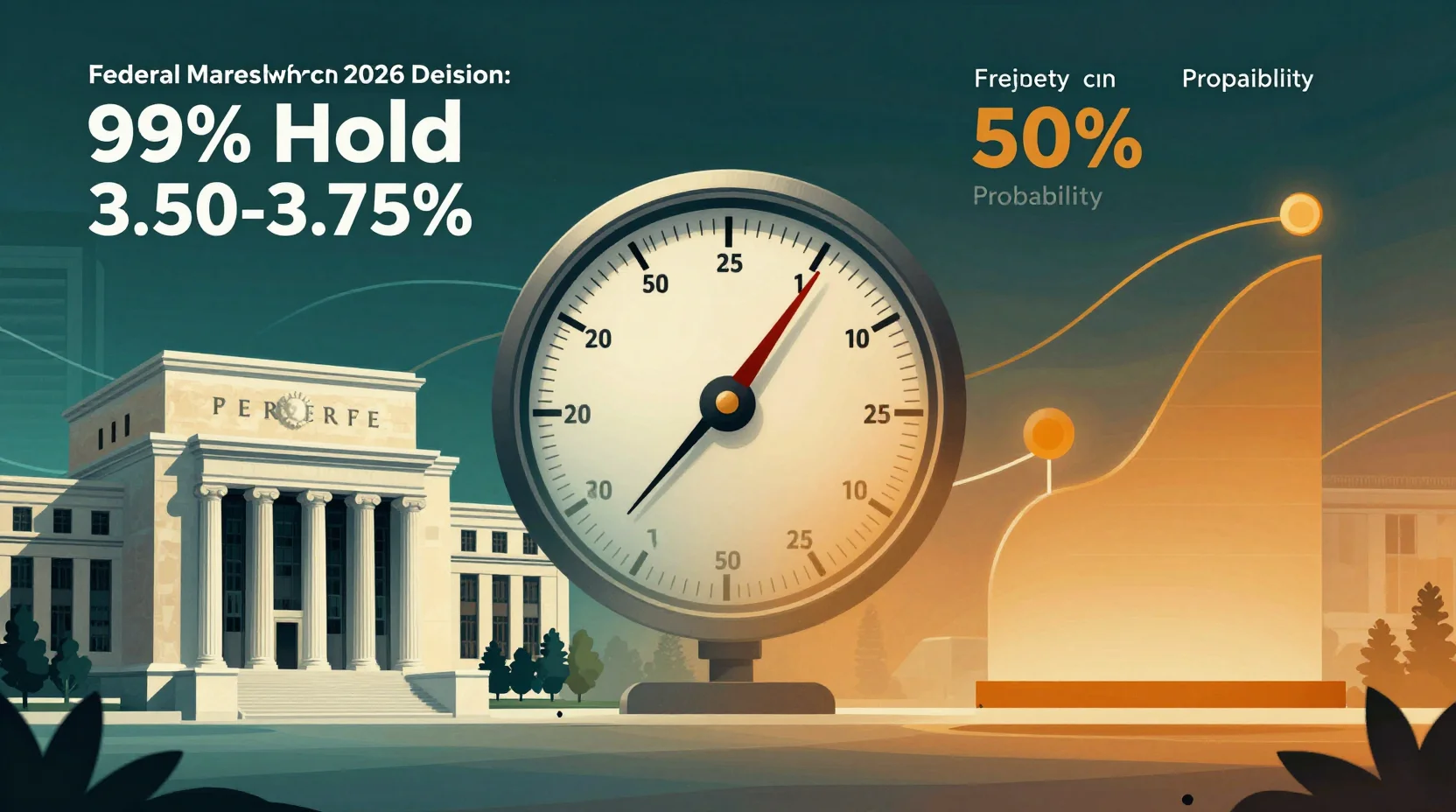
If you're holding your breath waiting for a Fed rate cut in March, you might want to exhale -- because this one is about as suspenseful as a movie where the trailer showed the ending. Markets are pricing in a 99% probability that the Federal Reserve will keep its hands firmly in its pockets and leave rates at 3.50-3.75%. Think of the Fed right now like a chef who just seasoned the stew with three consecutive cuts -- they want to taste it before adding more spice.
- Markets assign a 99% probability of no rate change at the March 18, 2026 FOMC meeting
- The Fed has paused after three consecutive 25 bps cuts totaling 75 basis points since late 2025
- Polymarket traders have put $141.7 million where their mouths are, and they're overwhelmingly betting on a hold
- The dot plot median projects only one more 25 bps cut for all of 2026 -- patience is the name of the game
Current Fed Funds Rate: 3.50-3.75% Target Range
The FOMC last met on January 29, 2026, voting to maintain the target federal funds rate at 3.50-3.75%. This came after three consecutive 25 basis point cuts in November and December 2025, bringing the total reduction to 75 basis points. In Fed-speak, the current rate level remains "restrictive" -- which is central banker for "we're still keeping the economy on a leash, but a slightly longer one."
According to the CME FedWatch tool, there's an 84.1% probability of unchanged rates at the March 19, 2026 FOMC meeting, with only a 15.5% chance of a 25 basis point cut and a 0.4% probability of a 50 basis point reduction. Better-than-expected January non-farm payroll data initially pushed the pause probability to 94.0% in early February before settling to current levels.
So why would the Fed cut when the job market is basically flexing on everyone?
Polymarket Prediction Market Data
The Polymarket prediction market for "Fed decision in March" tells an even more lopsided story: just 1% probability assigned to any rate change whatsoever. This market has attracted $141.7 million in trading volume with $4.6 million in liquidity -- that's not armchair speculation, that's serious money backing a serious conviction.
The divergence between CME FedWatch (15.5% chance of cut) and Polymarket (1% chance of any change) is worth noting. It likely reflects different market compositions and bet timing. But here's what matters: whether you ask the futures market or the prediction market, the answer is the same. The Fed is sitting this dance out.
Economic Indicators Supporting Rate Hold
The economic data reads like a permission slip for the Fed to do absolutely nothing. Let's break it down.
Employment Data
January 2026 non-farm payrolls exceeded expectations, and the labor market continues to flex strength that would make most central bankers comfortable. Unemployment hovers near historically low levels, and while wage growth has moderated from its post-pandemic highs, it remains above pre-pandemic averages. When your job market is this resilient, cutting rates aggressively would be like bringing an umbrella to a sunny day.
Inflation Metrics
Core PCE inflation -- the Fed's preferred gauge and the number they obsess over at dinner parties -- has cooled toward the 2% target but hasn't quite stuck the landing. Headline CPI has dropped more sharply thanks to falling energy prices, which has sparked some policy debate. Fed Chair Jerome Powell has emphasized the committee needs to see "sustained progress" toward 2% before loosening further. Translation: "Close isn't good enough."
GDP Growth
Fourth-quarter 2025 GDP growth showed the economy remains stubbornly resilient despite restrictive monetary policy. Consumer spending, business investment, and government expenditure have all contributed to steady expansion. If you were hoping for recession fears to force the Fed's hand, you'll need to look elsewhere.
Fed Officials' Projections and Communication
The December 2025 "dot plot" -- that constellation of anonymous dots representing each official's rate forecast -- showed a median projection of 3.375% by year-end 2026. That implies just one additional 25 basis point cut for the entire year. The range, however, spans from 2.125% to 3.875%, revealing significant disagreement behind closed doors. Some officials want to keep cutting; others think the job is done.
Recent public comments have stuck to the standard playbook: "data-dependent" decisions, acknowledgment that policy remains restrictive, and the diplomatic suggestion that the committee has "time to assess the effects of prior rate adjustments." In other words, don't call us -- we'll call you.
Key Data: March FOMC Decision Probabilities
| Source | Hold Probability | 25 bps Cut | 50 bps Cut | Volume |
|---|---|---|---|---|
| Polymarket | 99% | ~1% | <0.1% | $141.7M |
| CME FedWatch | 84.1% | 15.5% | 0.4% | N/A |
| Fed Dot Plot Median | Hold implied | -- | -- | N/A |
Factors That Could (But Probably Won't) Change the Calculus
Could something derail this near-certainty? Sure, in the same way a meteor could cancel your lunch plans. Here's what would need to happen:
Inflation Trajectory
If January and February core PCE readings show a surprise reacceleration, the Fed would double down on holding -- or even start talking hikes again. Conversely, a dramatic collapse in inflation could theoretically accelerate cuts, but "dramatic" is doing heavy lifting there.
Financial Stability
With equity indices near record highs and credit spreads tight, markets are giving the Fed zero reason to intervene. No banking stress, no credit freeze, no fire to put out.
Fiscal Policy Interactions
Ongoing budget negotiations add a wild card, but fiscal stimulus would actually reinforce the case for higher rates, not lower ones.
Global Economic Conditions
Slower global growth could eventually pull the Fed toward more cuts, but "eventually" and "March" are very different timelines.
Historical Context: Past Fed Pause Periods
History buffs, this pause follows a well-worn pattern. In 2019, the Fed cut rates three times (July, September, October) before pausing for five months -- a hiatus that only ended because a global pandemic crashed the party. In 2006-2007, the Fed held steady for over a year before the financial crisis forced its hand.
The lesson? Once the Fed hits pause after a cutting cycle, it tends to stay paused for a while. Like a driver who just parallel parked -- they're not moving again until they have a very good reason.
Market Expectations for 2026 Beyond March
Looking past March, the picture gets more interesting. CME FedWatch data suggests markets expect two additional rate cuts in 2026, with a 49.4% probability of a cut at the June 2026 meeting and 34.8% at October 2026. Rate futures imply the federal funds rate could reach approximately 3.0% by December 2026, down 50-75 basis points from current levels.
So while March is a foregone conclusion, the rest of 2026 is where your portfolio positioning actually matters. The Fed's dot plot median of 3.375% year-end aligns reasonably well with market pricing, suggesting the smart money and the Fed are reading from the same playbook -- for now.
Frequently Asked Questions
What is the current federal funds rate?
The Federal Reserve's target federal funds rate range is 3.50-3.75% as of January 29, 2026. This represents the upper bound of the target range, which is what the Polymarket market uses for resolution purposes.
When is the March 2026 Fed meeting?
The FOMC will hold its next scheduled two-day meeting on March 17-18, 2026, with the interest rate decision announcement expected at 2:00 PM ET on Wednesday, March 18, 2026.
What happens if the Fed changes rates by an amount not listed in Polymarket options?
Per Polymarket's rules, if the Fed changes the rate by an amount not expressed in the displayed options (e.g., 12.5 basis points), the change will be rounded up to the nearest 25 basis points and resolve to the relevant bracket. A 12.5 bps cut would be considered a 25 bps cut, for example.
How accurate have Fed rate predictions been historically?
CME FedWatch probabilities have been highly reliable, with the base case outcome occurring in approximately 80-85% of meetings over the past two years. Polymarket has a similarly strong track record, though its shorter history offers fewer data points.
Federal Reserve March 2026 Decision: Hold Forecast
Direction: Hold (No Change) | Probability: 99% | Horizon: 27 days (March 18, 2026) / Answer: Yes, the Fed will maintain rates at 3.50-3.75%
Methodology: This prediction is based on (1) Polymarket market data showing 99% probability of no change with $141.7 million in traded volume, (2) CME FedWatch data showing 84.1% probability of unchanged rates, (3) recent Fed communication emphasizing "data-dependent" approach following three consecutive cuts, (4) strong labor market data reducing urgency for further easing, and (5) Fed's own dot plot median showing minimal additional cuts expected in 2026.
Calculation Method: Polymarket reference with CME FedWatch confirmation
How to Trade This Prediction
The Federal Reserve's March 2026 rate decision is actively traded on Polymarket, letting you put real money behind your macro thesis.
Trading Options:
- If you believe rates will remain unchanged (99% probability): Buy "No change" shares at approximately 99 cents (potential +1% if correct)
- If you believe the Fed will cut rates (1% probability): Buy "-25 bps" shares at approximately 1 cent (potential +9,900% if correct -- yes, you read that right)
Current Market:
| Outcome | Share Price | Implied Probability | Potential Return |
|---|---|---|---|
| No change | 99 cents | 99% | +1% |
| -25 bps cut | 1 cent | 1% | +9,900% |
| +25 bps hike | <0.1 cents | <0.1% | +100,000% |
How It Works:
- Each share pays $1 if your selected outcome occurs, $0 if it doesn't
- Buy shares below $1 to profit from correct predictions
- Sell anytime before resolution to lock in gains or cut losses
Resolution Source: The FOMC's statement after their March 17-18, 2026 meeting, available at the official Federal Reserve website. The market may resolve as soon as the statement is released.
Risk Warning: Prediction markets involve financial risk. Only trade what you can afford to lose. Past accuracy does not guarantee future results. This is not financial advice.
Sources
- CME FedWatch Tool - Real-time Fed funds rate probabilities
- Polymarket Fed Decision Market - $141.7M prediction market
- Federal Reserve FOMC Calendar - Official meeting schedule
- Federal Reserve Monetary Policy - Current rate information
- FRED Blog - Interest Rates and Exchange Rates - Economic analysis