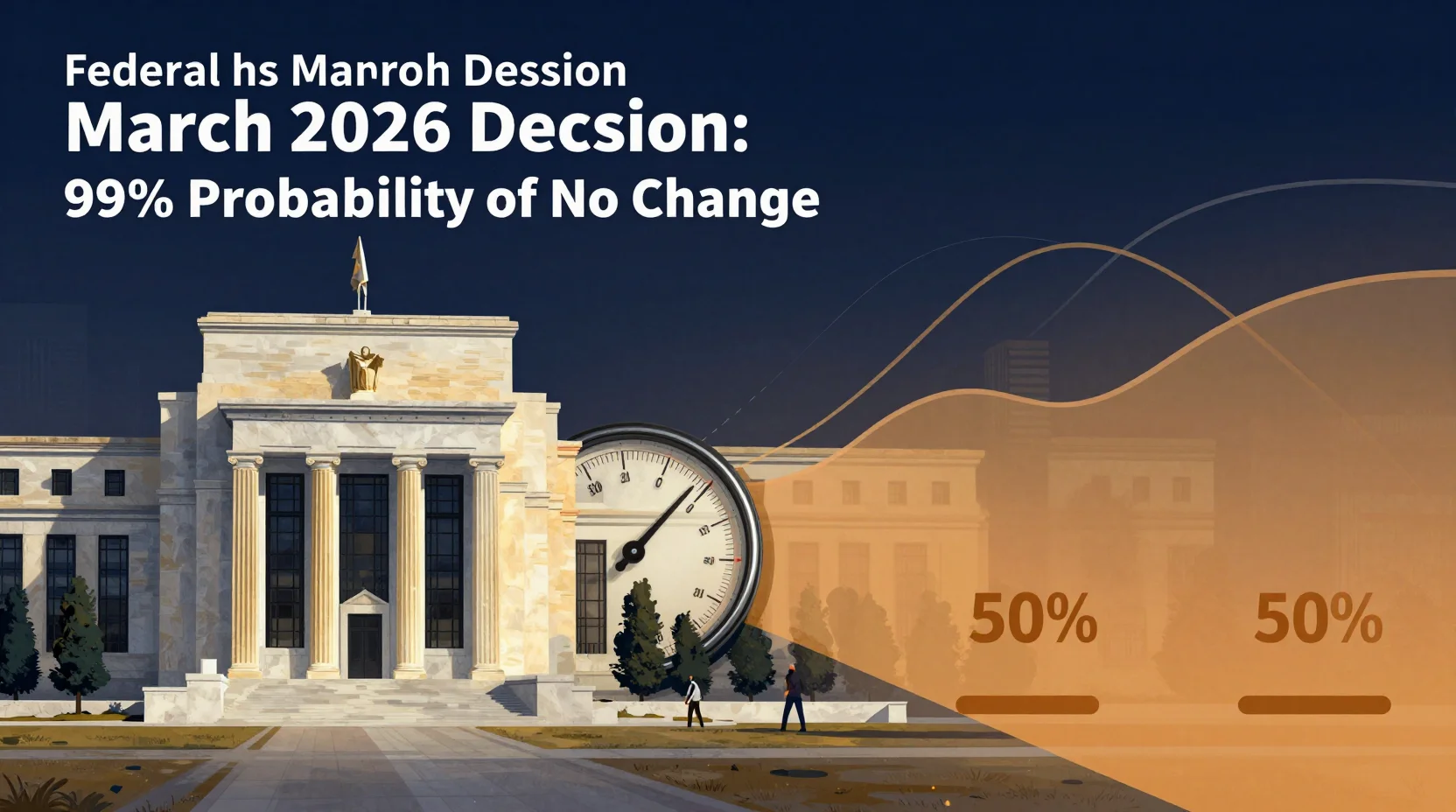
If you're waiting for the Federal Reserve to do something dramatic at its March 2026 meeting, you might want to bring a book — because the consensus is that nothing is going to happen. And by "consensus," we mean virtually everyone. According to Polymarket prediction markets, traders assign a 99% probability that the Fed will keep rates unchanged following the March 17-18, 2026 meeting. That's not a consensus; that's a standing ovation for the status quo.
- Prediction markets show 99% probability of no rate change at the March 17-18 FOMC meeting
- Only 1% of traders anticipate any adjustment — a level of agreement you rarely see outside of "is water wet?" debates
- The extraordinary consensus reflects either genuine economic stability or a market that's gotten a little too comfortable
- Inflation appears to have stabilized near the Fed's 2% target, removing the urgency for action
- Historical precedent warns that even "certain" outcomes occasionally produce surprises
Fed March 2026 Meeting: Current Market Expectations
The scheduled March 17-18, 2026 FOMC meeting represents a critical decision point for U.S. monetary policy — though "critical" might be generous when 99% of the market already knows the ending. Prediction markets indicate virtually no expectation of rate adjustments, with only 1% of traders anticipating any change to the federal funds target range. To put that in perspective, there's a higher probability of it snowing in Miami than of the Fed moving rates this month.
But here's the thing about near-unanimous market expectations: they make for terrible insurance premiums and occasionally spectacular surprises. Historical analysis shows that even when Fed intentions appeared crystal clear, unexpected shifts occurred due to inflation surprises, labor market volatility, or geopolitical events. The current 99% consensus for no change therefore represents either exceptional economic stability or potential complacency among traders. And if you've been watching markets long enough, you know that "this time it's different" are the four most expensive words in the English language.
Key Data: March 2026 FOMC Meeting Probabilities
| Outcome | Probability | Market Signal |
|---|---|---|
| No Rate Change | 99% | Overwhelming consensus |
| Any Rate Adjustment | 1% | Near-zero expectation |
| Meeting Dates | March 17-18, 2026 | Confirmed on Fed calendar |
| Resolution Source | FOMC Policy Statement | Released post-meeting |
| Reference Rate | Upper bound of target range | Basis for market resolution |
Factors Influencing the March 2026 Decision
Several key factors will determine whether the Fed maintains rates or pulls a plot twist that nobody saw coming. The Federal Reserve's official calendar confirms the March meeting dates, with the policy statement released immediately following conclusions. The upper bound of the target federal funds range serves as the reference point for this market, meaning any adjustment would be measured against the current ceiling rate.
Inflation trajectory remains the primary consideration for Fed policymakers — it's always about inflation, the way every Thanksgiving dinner eventually becomes about politics. While the exact inflation figures leading into March 2026 remain uncertain, the consensus for no change suggests price pressures have stabilized near the Fed's 2% target. Labor market conditions, GDP growth data, and financial stability considerations will also factor into the decision-making process. Market participants appear convinced that these metrics justify maintaining the current policy stance.
The Federal Reserve's official monetary policy resources provide the authoritative source for rate decisions. Following the March meeting, the FOMC statement will explicitly detail any changes to the target range, or confirm the continuation of current policy. This statement serves as the definitive resolution source for prediction markets and provides transparency for economic stakeholders.
What could possibly disrupt this serene picture? A surprise inflation print, an unexpected labor market shock, or a geopolitical event that rewrites the economic narrative overnight. These are low-probability scenarios, but "low probability" and "zero probability" are very different things — just ask anyone who held short positions on GameStop in January 2021.
Frequently Asked Questions
What is the Federal Reserve March 2026 decision date?
The Federal Open Market Committee (FOMC) meeting is scheduled for March 17-18, 2026, with the policy statement released immediately following the conclusion of deliberations.
Will the Fed change interest rates in March 2026?
Prediction markets indicate a 99% probability of no change to the federal funds rate, reflecting overwhelming consensus that current monetary policy settings will remain unchanged.
What happens if the Fed changes rates by an unusual amount?
If the Fed adjusts rates by an amount not exactly matching the displayed options (such as 12.5 basis points), the change will be rounded up to the nearest 25 basis points for resolution purposes.
Should traders bet on the 1% surprise scenario?
While contrarian bets can be lucrative, a 1% probability means you'd need extraordinary conviction — and extraordinary evidence — to justify the position. The risk/reward only makes sense if you have a specific thesis for why the consensus is wrong, not just a hunch that surprises happen.
How to Trade This
With 99% certainty priced in, there's almost no edge in betting on the expected outcome — the juice isn't worth the squeeze. The interesting play, if you have genuine conviction, is on the 1% tail risk, where the payout would be substantial if something unexpected materializes. Otherwise, the smarter approach is to position for the second-order effects: how will markets react to the Fed's forward guidance language? Watch the statement closely for any shifts in tone regarding future meetings, because while March may be a snooze, the June and September meetings are where the real action could unfold.
Fed March 2026 Decision: Rate Change Probability
Direction: No Change (Status Quo) | Probability: 99% | Horizon: March 17-18, 2026 (FOMC meeting dates) / Answer: No rate adjustment expected
The prediction market's extraordinary 99% confidence in no change reflects either remarkable economic stability or potential market complacency. While historical precedents exist for unexpected Fed decisions, current trader positioning suggests minimal probability of policy shifts at the March meeting. Economic data releases between now and March 17-18 could potentially alter this outlook, but the current consensus indicates broad satisfaction with existing monetary policy settings.