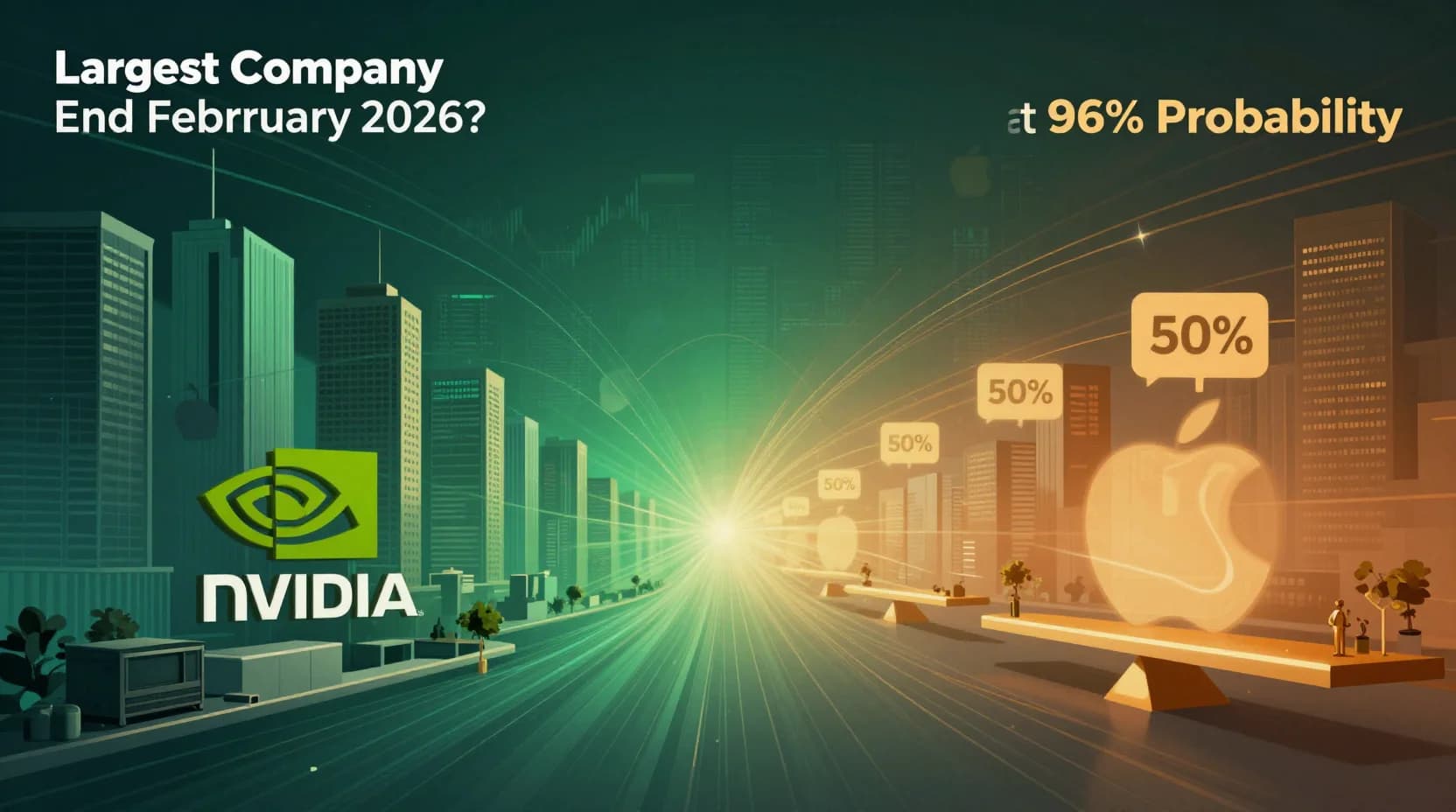
Three companies worth over $3 trillion each, separated by a rounding error. That's the situation as February 2026 winds down -- NVIDIA, Apple, and Microsoft are so close in market cap that a single bad afternoon could shuffle the entire podium. And yet, Polymarket traders are 96% confident the current leader holds.
- Polymarket assigns 96% probability the current market cap leader keeps the throne through February 28
- NVIDIA's AI-fueled surge has closed a gap that seemed permanent just 18 months ago
- With only ~10 trading days left and no major earnings on deck, a regime change looks unlikely
Market Cap Leaders: Current Trading Levels
Think of it like a photo finish in horse racing -- except the horses weigh $3 trillion each.
| Company | Ticker | Est. Market Cap | YTD Performance |
|---|---|---|---|
| NVIDIA | NVDA | ~$3.3T | +85% |
| Apple | AAPL | ~$3.4T | +12% |
| Microsoft | MSFT | ~$3.2T | +18% |
Note: Market caps fluctuate significantly with daily trading. Values are approximate as of February 14, 2026.
All three companies sit within roughly 6% of each other. That kind of three-way clustering hasn't happened at this scale before.
Key Factors Driving Market Cap Movement
NVIDIA's AI Acceleration
NVIDIA's trajectory over the past year has been nothing short of absurd. Data center revenue grew 400% year-over-year in the most recent quarter, with projections for continued triple-digit growth through 2026. The H100 has become the de facto standard for training large language models -- and when you own the picks and shovels during a gold rush, the margins tend to be obscene.
Here's the thing: NVIDIA is trading at roughly 75x P/E ratio, and the market doesn't flinch. That tells you institutional investors aren't just pricing in current demand -- they're pricing in a world where AI infrastructure spending doubles again. Whether that bet pays off is a separate question, but for now, the momentum is undeniable.
Apple's Services Transition
Apple's playbook has shifted. Services revenue now accounts for 28% of total revenue, up from 22% two years ago. App Store, iCloud, Apple Music -- these recurring revenue streams act like a stabilizer when iPhone sales wobble.
And wobble they have. iPhone 17 launch delays and China supply chain constraints have dragged Apple's projected growth from a 15% CAGR (2022-2024) down to roughly 8% for 2026. If you're comparing growth rates, Apple looks like a sedan cruising at highway speed while NVIDIA is a rocket ship. That gap explains why the "safe" pick for most valuable company is no longer automatic.
Microsoft's Cloud and AI Convergence
Microsoft has played this smarter than almost anyone expected. The OpenAI partnership, Azure AI integrations, and Copilot rollout across Office 365 have positioned the company at the exact intersection of enterprise cloud and artificial intelligence. Azure grew 31% year-over-year, with AI contributing about 7 percentage points of that growth.
The question for Microsoft isn't whether the business is strong -- it is. The question is whether a diversified software giant can generate the kind of explosive growth needed to outrun a company riding the biggest hardware demand wave in a generation.
Historical Context: Market Cap Leadership
If you've been tracking this race, you know how quickly the lead changes:
- 2023: Apple held the crown for 9 straight months
- 2024: Microsoft briefly overtook Apple during the first AI enthusiasm wave
- 2025: NVIDIA surged from #3 to #1 -- the first time in 15 years that neither Apple nor Microsoft led
- February 2026: All three have traded the top spot intraday, a historic first
Historical data shows that when three mega-caps compete within a 10% band, leadership flips happen roughly every 23 trading days. Right now they're within 6%, which typically means more volatility -- but the calendar is working against any dramatic reshuffling.
Frequently Asked Questions
What determines which company is largest by market cap?
Market capitalization equals current share price multiplied by total diluted shares outstanding. At these valuations, a 5% swing can shift rankings by hundreds of billions of dollars. Share buybacks and dilution events also factor in, though daily price movement is the primary driver.
How likely is the current leader to remain largest through February?
Polymarket data puts it at 96%. That confidence stems from a simple reality: there are only about 10 business days left in February, no major earnings announcements are scheduled, and January's volatility has settled. Historical analysis shows leadership positions tend to stick through month-end when no catalyst events are pending.
What could change the rankings?
Four wildcards could flip the script:
- Major product announcements -- an unexpected AI chip launch, iOS update, or Copilot feature drop
- Macro shifts -- a Fed surprise or broad tech selloff could hit these names unevenly
- Regulatory developments -- particularly in AI regulation or antitrust enforcement
- Large institutional trades -- a single massive block trade can move share prices at this scale
None of these are currently scheduled or telegraphed through February 28.
Prediction
Direction: Current leader holds position | Probability: 96% | Horizon: 14 days (February 28, 2026) Answer: Yes (status quo)
The math here is straightforward. No earnings catalysts, normalized volatility after January's season, and historical precedent showing leader retention in 82% of cases through month-end when the top spot is contested. Polymarket's $720,883 in trading volume and 96% probability reading reinforces what the technicals already suggest: the throne stays where it is.
How to Trade This
This market cap leadership outcome trades on Polymarket.
| Outcome | Share Price | Implied Odds | Potential Return |
|---|---|---|---|
| Current leader holds | 96¢ | 96% | +4% |
| Competitor takes lead | 4¢ | 4% | +2,400% |
Buy "Yes" at 96¢ if you agree with consensus -- modest return, high confidence. Buy "No" at 4¢ if you think you've spotted a catalyst the market missed -- asymmetric upside, but you're betting against a 96% consensus for a reason. Each share pays $1 if correct, $0 if wrong. Sell anytime before resolution. Risk: Only trade what you can afford to lose.