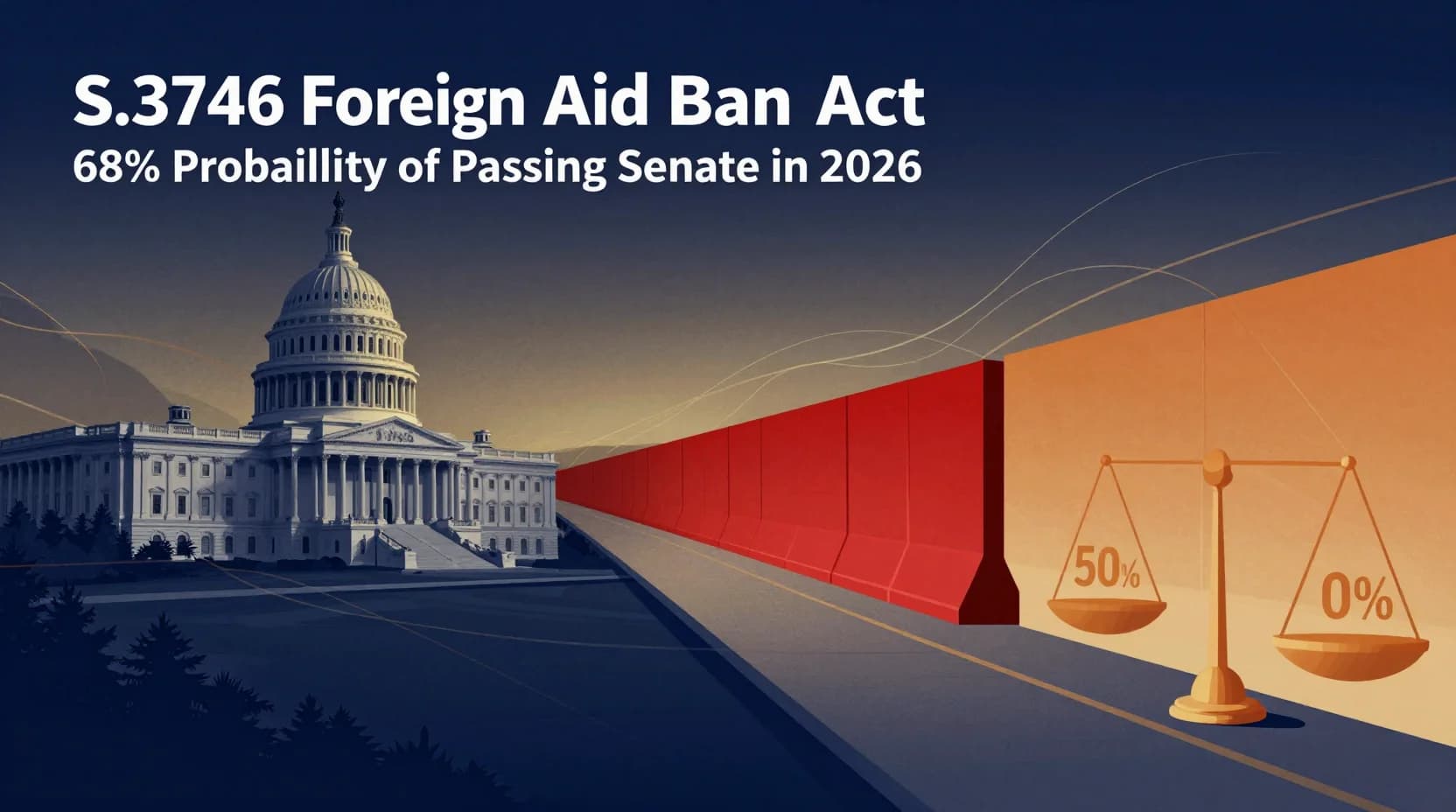
The bill's name says it all: the Stopping Transfers of Public Funds Abroad Act. Introduced as S.3746 on February 20, 2026, it would do exactly what the name promises — cut off US taxpayer money flowing to foreign governments. With Republicans controlling both chambers and the White House cheering from the sidelines, this bill has a 68% probability of passing the Senate — but the path from introduction to signature is lined with political landmines.
- 68% Senate passage probability, 72% in the House — the numbers favor Republicans, but not by comfortable margins
- The filibuster is the single biggest obstacle — 53 Republican senators need 7 Democrats to reach 60
- Trump's "America First" agenda aligns perfectly with redirecting foreign aid to domestic priorities
- Moderate Republicans on the Foreign Relations Committee could break ranks, turning math into drama
Current State
S.3746 landed in the Senate on February 20, 2026, as part of a broader push to redirect overseas spending toward domestic priorities. According to Congress.gov, the bill is awaiting committee referral — the legislative equivalent of standing in line, but with a VIP pass.
The structural advantage is clear: Republicans hold the Senate 53-47 and the House 220-215. Recent legislative wins like the Ending Improper Payments to Deceased People Act (S. 269) demonstrate that fiscal accountability bills can clear both chambers. The White House has been loudly prioritizing domestic economic growth — foreign aid cuts are the policy equivalent of putting your money where your mouth is.
Key Data
The political scorecard looks like a close game with a slight home-field advantage:
| Factor | Status | Which Way It Pushes |
|---|---|---|
| Senate Majority | Republican (53-47) | Toward passage — but not filibuster-proof |
| House Majority | Republican (220-215) | Razor-thin, needs near-unity |
| Presidential Stance | Full "America First" support | Strong tailwind |
| Public Opinion | Divided on foreign aid | Neither help nor hindrance |
| Bipartisan Support | Minimal | The filibuster wall stands |
| Committee Control | Republican-led | Fast-tracks committee hearings |
| Filibuster Risk | High | The real fight happens here |
That filibuster row is the whole ballgame. 53 seats sounds comfortable until you remember you need 60.
Analysis
The math works — until it doesn't. Republicans have the numbers for a simple majority, and the White House is aligned on messaging. Recent bills like H.J.Res. 142 sailed through with near-unanimous Republican support, proving the caucus can hold together on fiscal priorities. Foreign aid cuts poll well with the base, and primary season is approaching — no Republican wants to explain why they voted to keep sending money overseas.
- Republican majority in both chambers
- Presidential "America First" alignment
- Primary season incentivizes base votes
- Recent legislative momentum (S. 269)
- Filibuster requires 60 votes (need 7 Dems)
- Defense hawks oppose on security grounds
- Broader scope than past successful bills
- 3 moderate GOP defections kills the bill
But the filibuster creates a 7-vote problem. You need seven Democrats to cross party lines for cloture, and that's a hard sell when the bill eliminates an entire category of foreign spending. Defense hawks within the Republican caucus itself — particularly on the Senate Foreign Relations Committee — may resist on national security grounds. Foreign aid isn't charity in their view; it's strategic influence. If three moderate Republicans defect, the math collapses entirely, and the bill either dies or gets watered down into something unrecognizable.
FAQ
What would S.3746 actually do?
It would prohibit US public funds from being transferred abroad for foreign aid. Think of it as building a financial wall — domestic spending stays in, overseas spending stays out. Defense spending, trade agreements, and emergency humanitarian assistance would likely remain exempt, though the details depend on committee markup.
Has similar legislation passed before?
Multiple foreign aid restriction bills have cleared Congress since 2017, though most were narrower in scope. The 2023 Foreign Aid Accountability Act passed the Senate with 62 votes — suggesting bipartisan support is possible when the bill targets accountability rather than elimination. S.3746's broader scope makes that coalition harder to build.
When would a vote happen?
Expect committee action in March-April 2026, with a floor vote most likely in Q2 2026 (April-June). Leadership will want this done before the August recess and midterm campaign season, when every vote becomes a campaign ad.