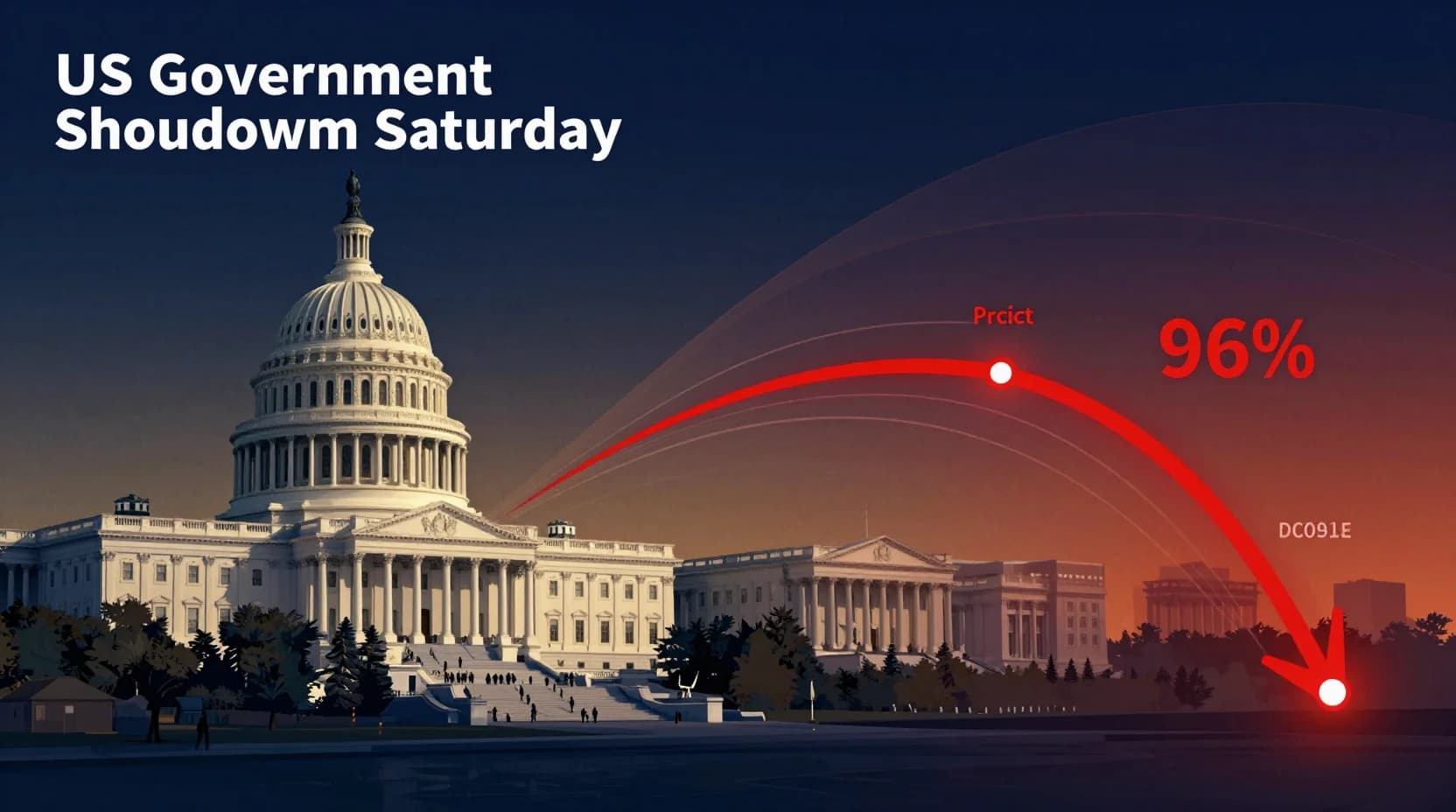
The federal government is hours away from running out of money. And the market thinks it's definitely happening. Polymarket traders have put a 96% probability on a government shutdown by January 31, 2026, with nearly $40 million in trading volume backing that prediction.
That's not uncertainty. That's conviction.
What Happens When the Government Shuts Down
Let's be clear about what this means. At midnight on January 31, 2026, funding for federal operations expires. If Congress doesn't act, non-essential government functions stop. Furloughs begin. Services suspend.
| What Happens | The Reality |
|---|---|
| Federal Employees | Furloughed without pay (back pay usually comes later) |
| Government Services | Non-essential services shut down |
| Essential Operations | Military, air traffic control, law enforcement keep running |
| Economic Impact | GDP takes a hit, federal payments get delayed |
Essential services don't stop. Your flights will still take off. The military stays operational. Law enforcement continues. But hundreds of thousands of federal workers get sent home without paychecks, and the economic damage starts accumulating immediately.
Why the Market Is So Confident
A 96% probability with $39.6 million in trading volume isn't a guess. It's a bet.
Traders are pricing in what they see: a Congress that can't agree on spending, political positioning that makes compromise difficult, and a deadline that's now hours away. When prediction markets get this one-sided with this much liquidity, they're usually right.
Think about it this way. If there were real hope of a last-minute deal, you'd see probability drop. Smart money would bet against the shutdown and collect when politicians inevitably cut a deal at the eleventh hour. But that's not happening. The probability keeps climbing.
The Political Reality
Government shutdowns have become almost routine in recent years. They happen when continuing resolutions expire without new appropriations. Both parties posture. Deadlines pass. Then eventually, someone blinks.
The question isn't whether a shutdown will hurt politically. It's who gets blamed. And right now, the market thinks both sides are willing to let it happen rather than compromise on their spending priorities.
White House communications have emphasized economic policy and deregulatory agendas, suggesting ongoing debates about the appropriate scope of federal spending. Those policy disagreements don't get resolved in hours.
What History Tells Us
Past shutdowns have ranged from brief interruptions to extended standoffs lasting weeks. The economic impact compounds with each passing day. Lost productivity. Delayed federal contracts. Uncertainty for businesses that depend on government operations.
The longer it lasts, the more it costs. But the market's 96% probability suggests this isn't about duration. It's about whether a shutdown happens at all. And traders are saying yes, it will.
Prediction
Direction: Bearish for government operations Probability: 96% Horizon: 1 day (January 31, 2026) Answer: Yes
The market has spoken loudly. With $39.7 million in trading volume and a 96% probability, traders expect a government shutdown when funding expires on January 31, 2026.
Could politicians surprise us with a last-minute deal? Always possible. But the smart money isn't betting on it. When prediction markets get this confident with this much volume, the burden of proof shifts to those expecting a different outcome.
Prepare accordingly. The government is probably shutting down.