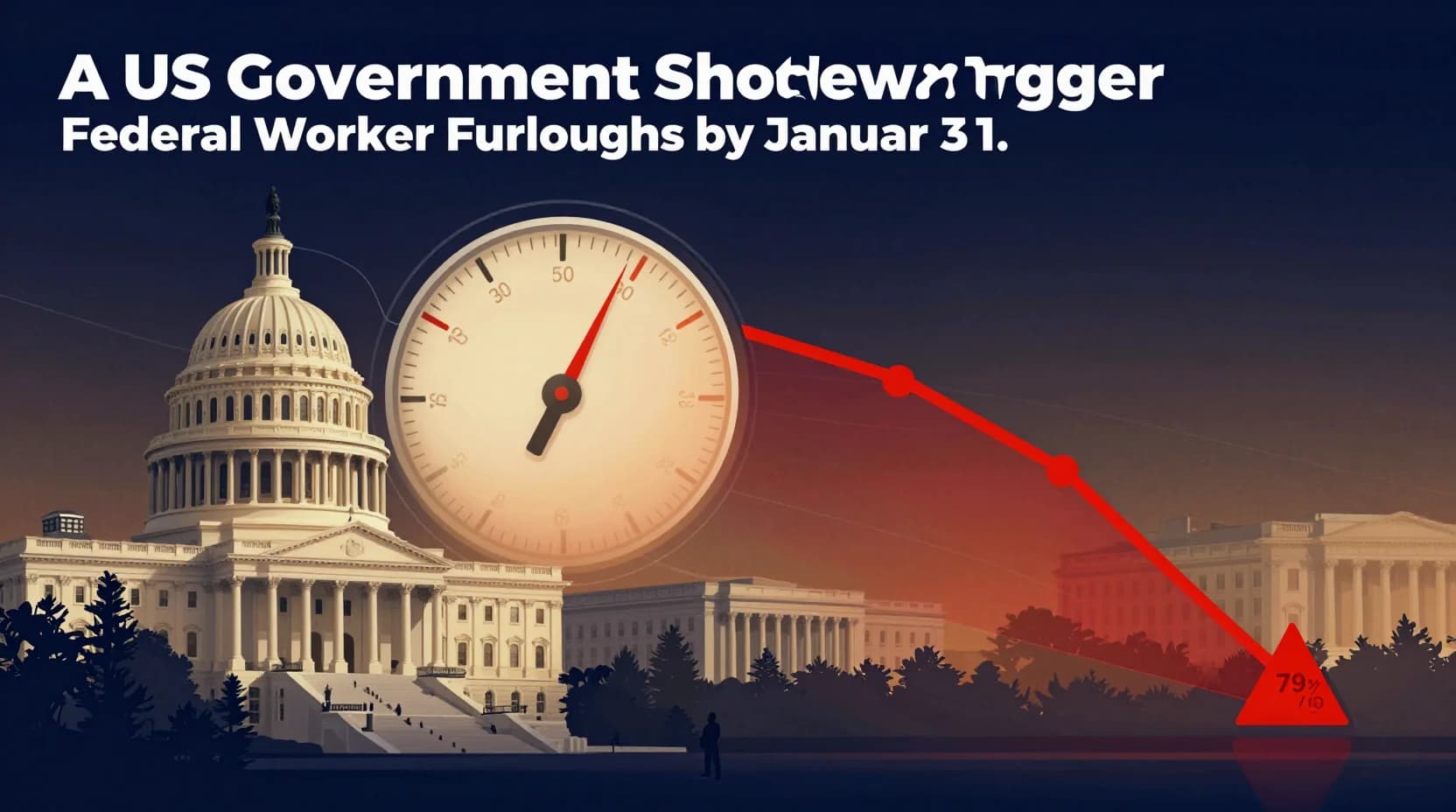
As the January 31 funding deadline approaches, federal workers face the possibility of furloughs if Congress fails to pass continuing appropriations or a full budget. Prediction markets currently assign a 79% probability to a government shutdown occurring by this deadline, reflecting significant uncertainty about congressional action.
- Prediction markets currently assign a 79% probability to a government shutdown occurring by this deadline, reflecting significant uncertainty about congressional action
- The current 79% "Yes" probability reflects trader expectations that congressional negotiators will not reach an agreement in time
- Congressional Calendar
Current Situation
The federal government operates on temporary funding measures that require periodic renewal by Congress. When these measures expire without new appropriations, non-essential government functions cease, resulting in furloughs for federal employees. According to the U.S. Office of Personnel Management, furloughed workers are placed in temporary non-duty, non-pay status.
Historical data shows that government shutdowns have occurred multiple times in recent decades, with varying durations and impacts. The longest shutdown in U.S. history lasted 35 days from December 2018 to January 2019, affecting approximately 800,000 federal employees.
Federal Worker Impact
During a government shutdown, federal agencies must determine which employees are excepted (essential) and which are furloughed (non-essential). Excepted employees continue working without pay until appropriations are restored, while furloughed employees are prohibited from performing any work duties.
| Category | Status | Pay During Shutdown | Back Pay |
|---|---|---|---|
| Excepted Employees | Work without pay | No | Yes (retroactive) |
| Furloughed Employees | Temporary unpaid leave | No | Yes (typically) |
| Contractors | Varies by contract | Varies | No guarantee |
The Congressional Research Service reports that federal workers typically receive retroactive pay after shutdowns end, as provided by legislation passed in 2019 (P.L. 116-1). However, this back pay does not compensate for lost interest, late payment penalties, or financial stress caused by delayed income.
Historical Shutdown Frequency
Since 1976, there have been 22 government funding gaps, with 10 resulting in federal employee furloughs. The frequency has increased in recent years, with 4 shutdowns occurring between 2018 and 2019 alone.
| Decade | Funding Gaps | Furloughs | Longest Duration |
|---|---|---|---|
| 1980s | 7 | 5 | 3 days (1987) |
| 1990s | 5 | 2 | 21 days (1995-96) |
| 2000s | 2 | 0 | N/A |
| 2010s | 6 | 4 | 35 days (2018-19) |
| 2020s | 2 | 1 | 3 days (2018-19 transition) |
Prediction market data shows approximately $11.9 million in trading volume on the question of a shutdown by January 31, indicating substantial market interest in the outcome. The current 79% "Yes" probability reflects trader expectations that congressional negotiators will not reach an agreement in time.
Key Factors
Several factors influence the likelihood of a shutdown by January 31:
Congressional Calendar: The limited legislative days remaining before the deadline reduce negotiation time.
Policy Disagreements: Outstanding disagreements on appropriations levels and policy riders complicate consensus-building.
Continuing Resolution: Congress may pass a short-term continuing resolution (CR) to extend funding temporarily, though this merely postpones rather than resolves the underlying issue.
Political Pressure: Previous shutdowns have resulted in public blame directed at both parties, creating political incentives to avoid furloughs.
Historical analysis shows that when funding gaps occur, furloughs typically begin immediately after the expiration of appropriations. The Antideficiency Act (31 U.S.C. 1341) prohibits federal agencies from obligating or expending funds without congressional authorization, necessitating workforce reductions during funding lapses.