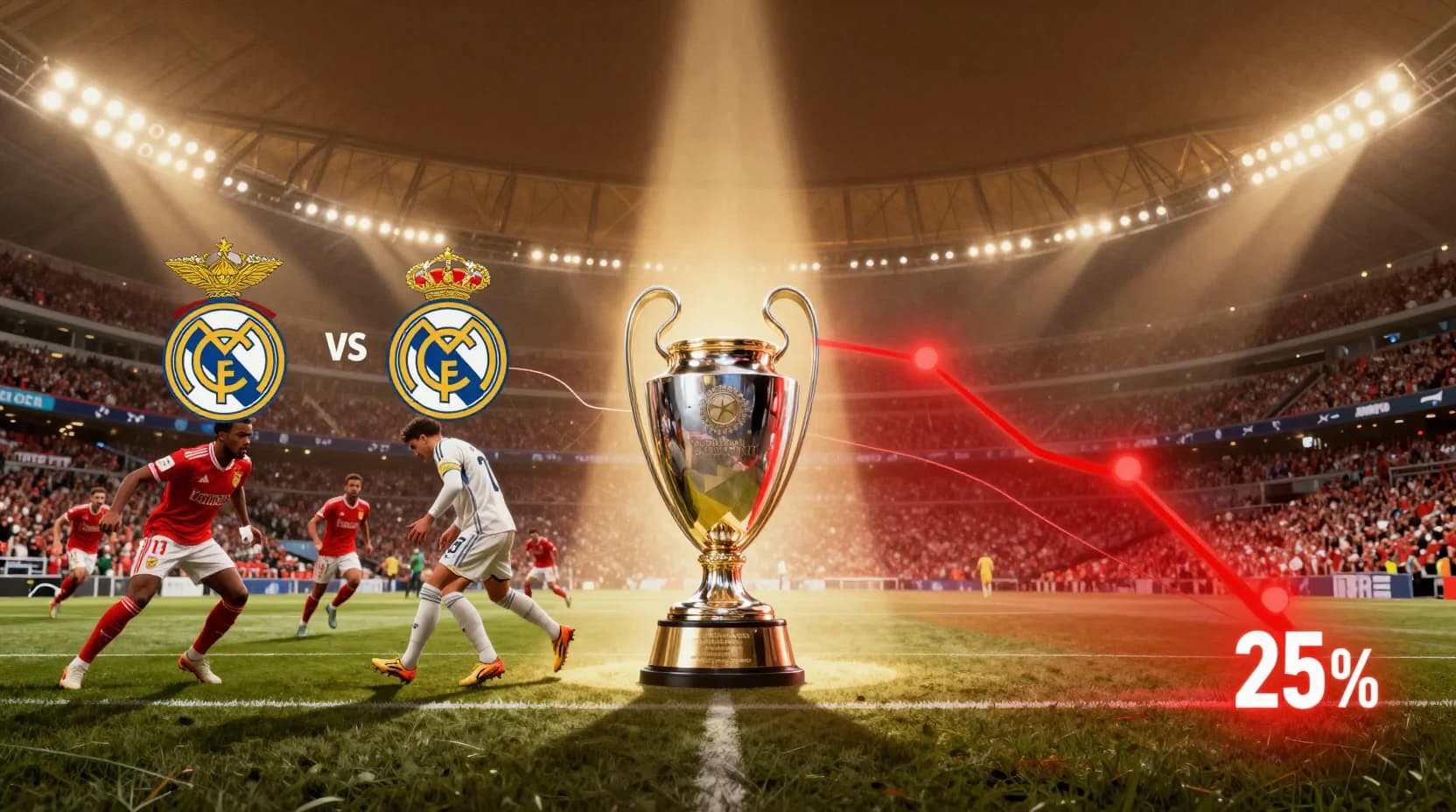
Real Madrid travels to Lisbon to face Benfica in a Champions League group stage fixture on January 29, 2026. The match comes at a turbulent time for Los Blancos, who recently dismissed their head coach and are currently under interim management. Polymarket traders give Benfica just a 25% probability of victory, reflecting the significant quality gap between the two sides despite Real Madrid's off-field turmoil.
- Polymarket traders give Benfica just a 25% probability of victory, reflecting the significant quality gap between the two sides despite Real Madrid's off-field turmoil
Current Situation
Real Madrid enters this match in unusual circumstances. The club abruptly fired their permanent head coach without a replacement lined up, leaving a caretaker manager to see out the remainder of the season. This disruptive decision mirrors a similar situation at Manchester United, where managerial instability has raised questions about the club's direction and decision-making processes. Despite the coaching upheaval, Real Madrid's squad depth and individual quality remain superior to most European opponents.
Benfica, meanwhile, sits in a more stable position domestically but faces the daunting challenge of containing a Real Madrid side that, even in transition, possesses world-class talent throughout the roster. The Portuguese side will need an exceptional performance to overcome both the quality deficit and the historical weight of European competition.
Polymarket Data
| Metric | Value |
|---|---|
| Benfica Win Probability | 25% |
| Trading Volume | $897,816 |
| Liquidity | $1,557,235 |
| Market Sentiment | Strongly favors Real Madrid |
The substantial trading volume and liquidity indicate significant market interest in this fixture, with traders expressing strong conviction that Real Madrid will emerge victorious despite their managerial instability.
Key Factors
Real Madrid's managerial disruption presents both risks and potential opportunities. Historically, clubs that undergo mid-season coaching changes often experience short-term volatility as players adjust to new tactical approaches and interim management structures. However, elite squads with established leadership groups can sometimes rally around the uncertainty, using the disruption as motivation to prove their quality regardless of who stands on the sidelines.
The caretaker manager appointment means Real Madrid lacks long-term strategic planning for this match. Instead, the interim setup likely emphasizes defensive organization and reliance on individual brilliance from star players. This approach could prove effective against Benfica if Real Madrid's attacking players can capitalize on limited opportunities. Conversely, the lack of coherent tactical preparation could expose Real Madrid to counter-attacks if Benfica presses aggressively and exploits any defensive disorganization.
Benfica's path to victory requires exploiting Real Madrid's transitional phase. The Portuguese side must maintain defensive compactness while seeking opportunities to catch Real Madrid off guard during moments of poor communication or unclear defensive responsibilities. However, the quality differential between the squads means Benfica likely needs additional advantages, such as early goals or Real Madrid player injuries/suspensions, to secure a positive result.
The Champions League context also matters. With group stage standings potentially impacted by this result, both teams have meaningful incentives to perform well. Real Madrid typically elevates their performance in European competition, regardless of domestic turmoil or coaching changes. This historical tendency suggests that even a caretaker manager will extract maximum effort from a squad accustomed to European success.