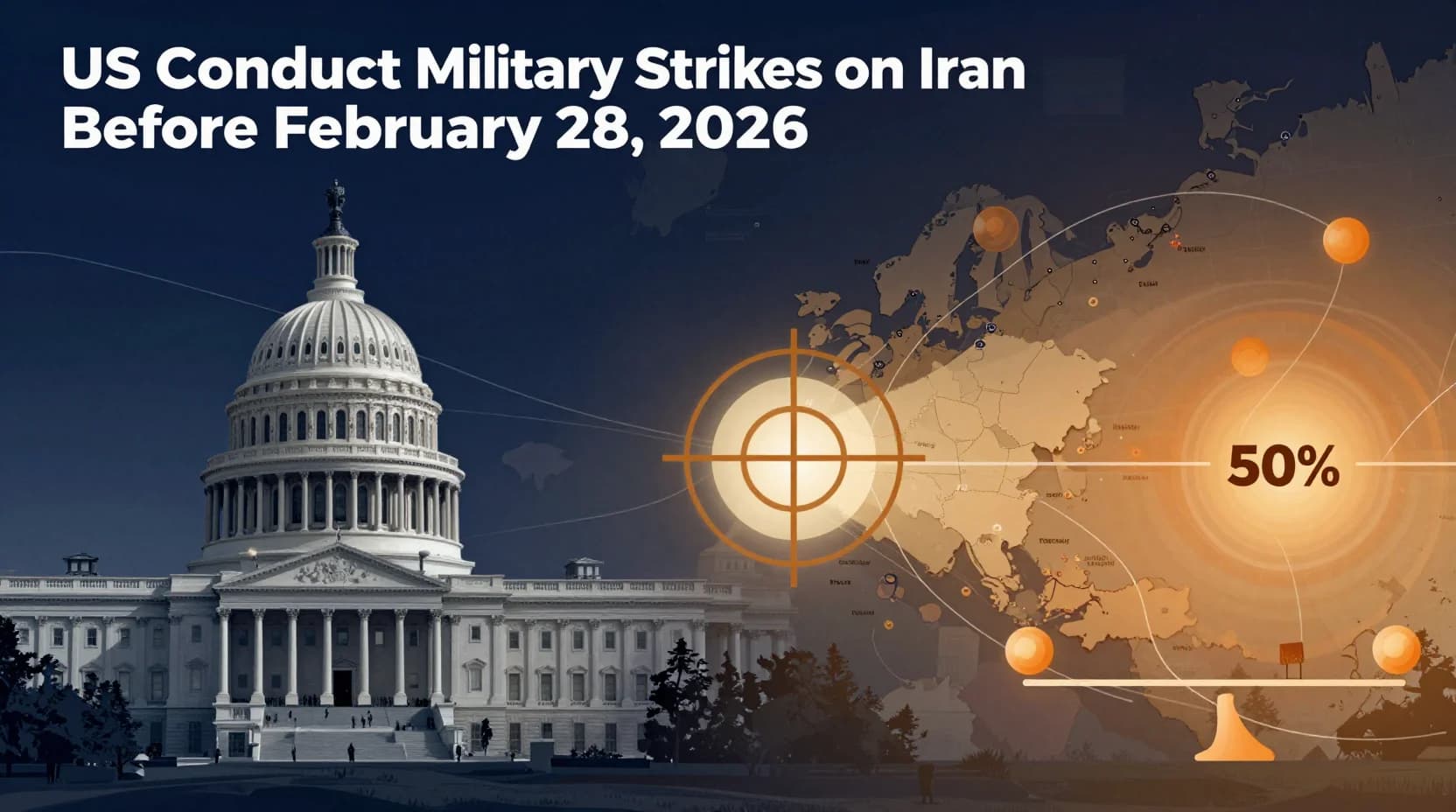
Two aircraft carriers. A "massive" armada. Weeks-long battle plans already drawn up. The Pentagon is not bluffing -- and yet, diplomatic channels remain open. That contradiction is exactly why prediction markets are pricing US military strikes on Iran at a coin-flip 50% before the February 28 deadline.
- Prediction markets assign a 50% probability to US strikes on Iran before February 28
- Two carrier strike groups and a full armada are positioned within striking distance of Iran
- Iranian officials have signaled willingness to compromise, keeping the diplomatic window cracked open
Here is what makes this situation genuinely unprecedented: the US is simultaneously preparing for war and negotiating for peace. Think of it as revving your engine while also asking for directions. Both signals are real. Both cannot be sustained.
Current US Military Posture: Escalation Readiness
The Pentagon has confirmed preparations for sustained operations lasting potentially weeks -- not hours, not a surgical one-off. This is a fundamentally different posture than anything seen in previous US-Iran confrontations.
What is already deployed tells the story:
| Asset | Status | Significance |
|---|---|---|
| Two carrier strike groups | In-region | Full offensive capability |
| USS Abraham Lincoln | Leading armada near Iran | Primary strike platform |
| Fighter jets & missile destroyers | Staged in Persian Gulf | Extended operation support |
| Forward-deployed assets | Positioned for weeks-long ops | Sustained engagement capacity |
If you are watching global markets, energy prices, or defense stocks, this deployment profile should have your full attention.
Iran's Military Capabilities: Damaged but Dangerous
Iran took a beating during the 12-day war with Israel, but writing off its military capability would be a serious miscalculation. The Institute for the Study of War describes Iran's remaining arsenal as "significant," including ballistic missiles, substantial manpower, and regional proxy forces capable of targeting US assets across the entire Middle East.
Think of Iran's military position like a boxer who lost the last round but still has knockout power. Degraded? Yes. Defanged? Not even close.
The 60-Day Nuclear Deadline
This crisis has a specific origin. Trump imposed a two-month deadline for Iran to reach a nuclear agreement. That deadline came and went without a deal. What followed was rapid escalation: Israel attacked Iran, and the US then struck three Iranian nuclear sites directly.
The progression from containment to active military engagement happened faster than most analysts predicted. And the February 28 date now functions as a second, implicit deadline where the military option either gets exercised or shelved.
Diplomatic Window: Closing or Still Open?
Here is the wildcard. Despite the warships and battle plans, Iranian officials have indicated readiness to consider compromises on the nuclear program. That is not nothing. But the simultaneous military buildup suggests the Trump administration has declining faith in diplomacy alone.
If you have watched past US-Iran cycles, you know the pattern: sanctions, threats, last-minute talks, temporary de-escalation. What makes 2026 different is the overt preparation for sustained strikes rather than proportional responses. This is not a warning shot -- it is a loaded weapon.
Key Factors Influencing the February 28 Deadline
Four variables will determine which way this falls:
Military Readiness: US forces are at peak preparedness. Weeks-long operational plans are finalized, assets positioned, supply chains activated. When you spend this much money moving hardware into position, the cost of not using it creates its own momentum.
Diplomatic Progress: Negotiations continue, but Iran has rejected US offers on ballistic missile talks. Every rejected proposal narrows the diplomatic runway.
Regional Dynamics: The 12-day Israel-Iran war already drew the US into direct strikes on Iranian nuclear facilities. The precedent for military engagement is now set.
Domestic Political Calculus: The Trump administration has combined maximum pressure with diplomatic overtures. Which instinct wins in the final 13 days is the trillion-dollar question.
Historical Context: Why 2026 Is Different
Previous US-Iran tensions followed a predictable pattern: proxy conflicts, cyber operations, economic sanctions, the occasional naval incident. Military action stayed in the realm of "credible threat" without execution.
| Previous Approach | 2026 Shift |
|---|---|
| Proxy conflicts | Direct strikes on nuclear sites |
| Cyber operations (Stuxnet era) | Carrier strike groups deployed |
| Economic sanctions as primary tool | Weeks-long military operations planned |
| Limited proportional responses | Sustained multi-phase campaign |
The shift from "credible threat" to "active preparation" is what makes the 50% market pricing feel about right. This is not posturing -- it is positioning.
Frequently Asked Questions
What is the probability of US military strikes on Iran before February 28, 2026?
Prediction markets assign a 50% probability to US military strikes on Iran before the February 28 deadline. The balanced pricing reflects genuine uncertainty between escalating military preparations and ongoing diplomatic efforts.
How long would US military operations against Iran last?
US military officials have indicated preparations for potentially weeks-long operations, suggesting sustained rather than limited strikes if military action is ordered.
What are Iran's military capabilities after the 12-day war with Israel?
Despite damage from Israeli airstrikes, Iran retains significant capabilities, including ballistic missiles, military manpower, and regional proxy forces that could threaten US assets across the Middle East.
Are diplomatic negotiations still ongoing?
Yes, diplomatic talks continue between US and Iranian officials, with Iran indicating readiness to consider compromises on its nuclear program, though parallel military preparations raise serious questions about diplomatic confidence.
US Military Strike Prediction: February 28, 2026 Forecast
Direction: Uncertain/Neutral | Probability: 50% | Horizon: 13 days (February 28, 2026) Answer: Too Close to Call
The balanced 50% probability reflects genuine uncertainty between two powerful drivers: significant military preparation suggesting imminent action, and ongoing diplomatic negotiations offering a peaceful off-ramp. The February 28 endpoint creates a decision window where either outcome remains plausible.
How to Trade This Prediction
This prediction trades on Polymarket. Buy "Yes" shares at 50¢ (50% implied probability) if you agree, or "No" at 50¢ if you disagree. Each share pays $1 if correct, $0 if wrong. Sell anytime before resolution. Trading volume: $28.4 million. Risk: Only trade what you can afford to lose.