A privacy protocol you may not have heard of just raised $118 million in commitments before a single token hit the open market. Zama's encrypted ICO is targeting a fully diluted valuation between $600 million and $1 billion by launch day -- numbers that would make most Series B startups jealous. The Token Generation Event drops in February 2026, and prediction markets are already pricing in serious upside.
- Zama raised $118 million in pre-TGE commitments, signaling strong institutional conviction
- Polymarket gives 53% probability to an $800M FDV outcome -- well above the $500M question mark
- The broader crypto liquidity drought is the biggest headwind, with Bitcoin tracking SaaS stock declines rather than crypto narratives
Current Situation
Zama completed its pre-TGE sale through Binance Web3 Wallet, with token distribution kicking off February 2, 2026. The auction mechanism is unusual -- an encrypted sealed-bid system that prevents front-running and whale manipulation during price discovery. OG NFT holders got in at $0.005 per token, with early investors anchoring at a $55 million FDV.
Here's what Polymarket thinks happens next: the $800 million FDV bracket sits at 53% probability, making it the consensus outcome among traders putting real money on the line. That's not a moonshot bet -- that's the market's base case.
Technical Analysis
The prediction market data paints a clear picture of where traders see Zama landing:
| Polymarket Market | Probability | Volume |
|---|---|---|
| FDV above $800M | 53% | $5,599 |
| FDV above $1B | 30% | $2,790 |
| FDV above $2B | 21% | $4,224 |
| FDV above $3B | 7% | $1,360 |
| FDV above $4B | 5% | $4,168 |
For context, comparable privacy protocol launches tell a similar story. Aztec holds a 56% probability of reaching $500M FDV, while Felix Protocol shows 86% confidence for a much more modest $25M target. The pattern suggests privacy protocols with strong technical foundations consistently land in the $500M to $1B range -- making Zama's $500M question less of an "if" and more of a "by how much."
Key Factors
That $118 million war chest is doing heavy lifting here. Think of it as the difference between a restaurant opening with a line around the block versus one hoping for walk-ins. The capital is already committed; the question is whether the broader market cooperates when those tokens start trading.
And that's where things get tricky. February 2026's crypto landscape is showing cracks. A liquidity drought has digital asset prices mirroring SaaS stock declines -- not exactly the backdrop you want for a splashy token launch. When Bitcoin is taking cues from enterprise software earnings instead of halving cycles, you know the speculative appetite has cooled.
But privacy protocols have a card most tokens don't: utility that doesn't evaporate when prices dip. Fully homomorphic encryption (FHE) -- Zama's core technology -- enables computation on encrypted data without decrypting it. That's not a "maybe someday" use case. Financial institutions, healthcare providers, and governments need this today. Demand for confidential transactions stays consistent regardless of whether Bitcoin is at $30K or $100K.
The wildcard is distribution timing. When tokens hit wallets on February 2nd, early investors sitting on $0.005 entries will face enormous paper gains. History shows that rapid supply increases from token distributions create selling pressure -- like a dam releasing water all at once instead of gradually. If enough early holders cash out simultaneously, it could temporarily suppress the FDV below target levels.
Prediction
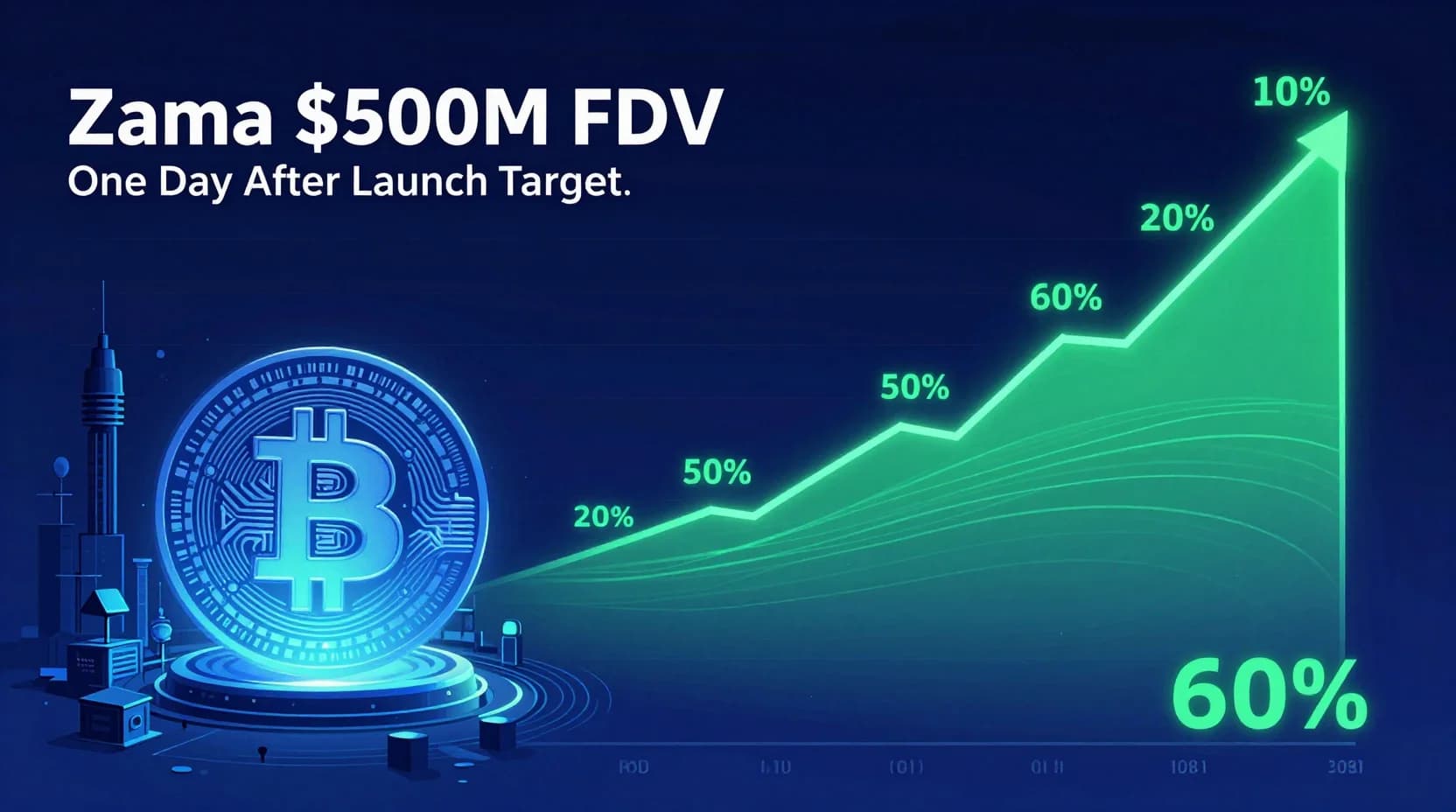
Direction: Bullish | Probability: 60% | Horizon: 1 day after token launch Answer: Yes
The math favors Zama clearing $500M FDV. With $118 million already committed and Polymarket pricing the $800M outcome at 53%, the $500M threshold looks like a floor rather than a ceiling. The encrypted sealed-bid mechanism should provide orderly price discovery, and comparable privacy launches support this valuation range. The main risk? A crypto market running on fumes when Zama needs it running on rocket fuel. But even in a soft market, 60% probability feels right for a protocol with this much committed capital and genuine technical differentiation.